


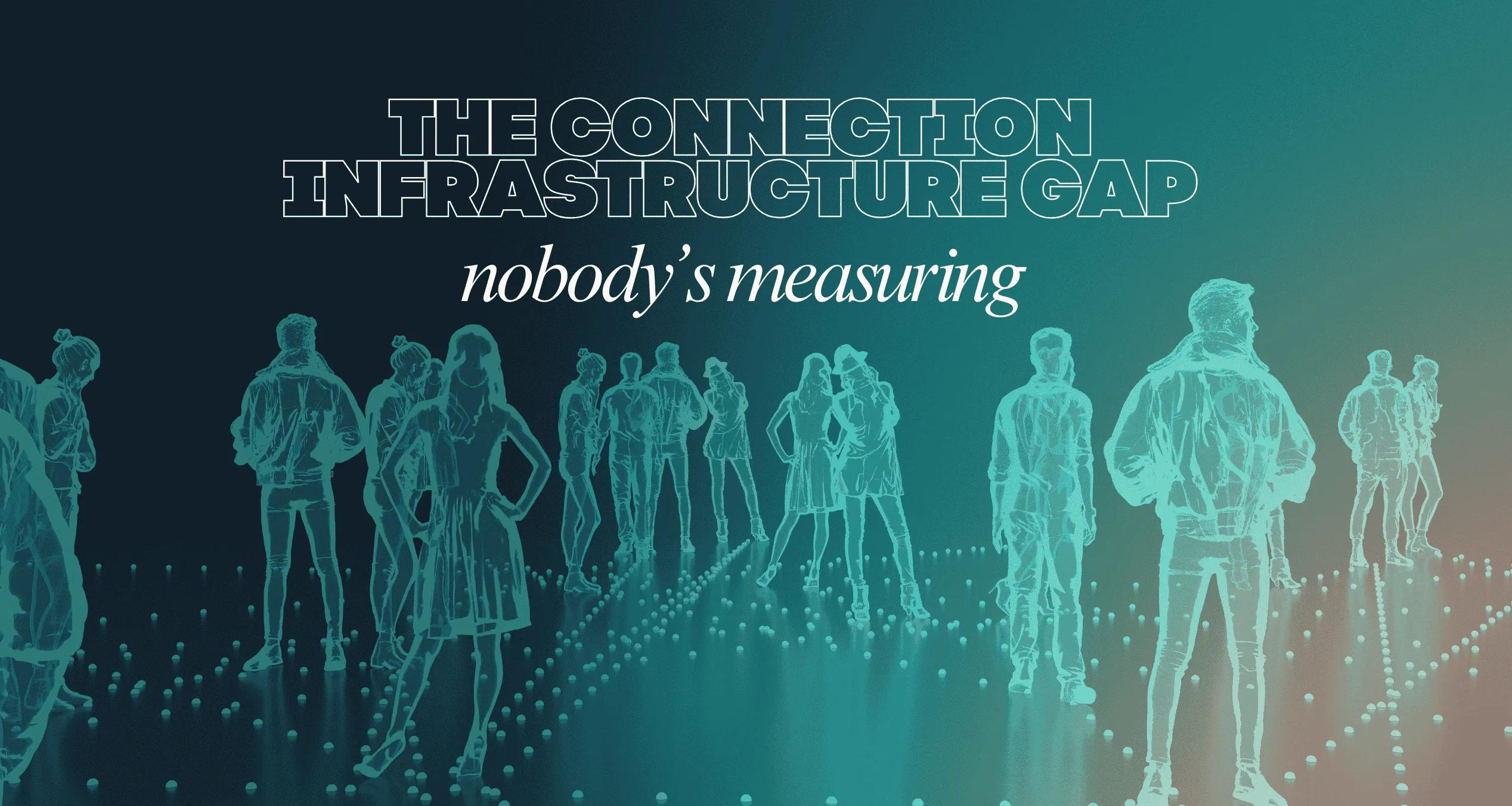
The Connection Infrastructure Gap Nobody's Measuring
If your event cannot show what moved after people met, it is just an expensive gathering. This article argues that relationship momentum, not moments, is the only product that will survive what is coming.
Interview multiple candidates
Lorem ipsum dolor sit amet, consectetur adipiscing elit proin mi pellentesque lorem turpis feugiat non sed sed sed aliquam lectus sodales gravida turpis maassa odio faucibus accumsan turpis nulla tellus purus ut cursus lorem in pellentesque risus turpis eget quam eu nunc sed diam.
Search for the right experience
Lorem ipsum dolor sit amet, consectetur adipiscing elit proin mi pellentesque lorem turpis feugiat non sed sed sed aliquam lectus sodales gravida turpis maassa odio.
- Lorem ipsum dolor sit amet, consectetur adipiscing elit.
- Porttitor nibh est vulputate vitae sem vitae.
- Netus vestibulum dignissim scelerisque vitae.
- Amet tellus nisl risus lorem vulputate velit eget.

Ask for past work examples & results
Lorem ipsum dolor sit amet, consectetur adipiscing elit consectetur in proin mattis enim posuere maecenas non magna mauris, feugiat montes, porttitor eget nulla id.
- Lorem ipsum dolor sit amet, consectetur adipiscing elit.
- Netus vestibulum dignissim scelerisque vitae.
- Porttitor nibh est vulputate vitae sem vitae.
- Amet tellus nisl risus lorem vulputate velit eget.
Vet candidates & ask for past references before hiring
Lorem ipsum dolor sit amet, consectetur adipiscing elit ut suspendisse convallis enim tincidunt nunc condimentum facilisi accumsan tempor donec dolor malesuada vestibulum in sed sed morbi accumsan tristique turpis vivamus non velit euismod.
“Lorem ipsum dolor sit amet, consectetur adipiscing elit nunc gravida purus urna, ipsum eu morbi in enim”
Once you hire them, give them access for all tools & resources for success
Lorem ipsum dolor sit amet, consectetur adipiscing elit ut suspendisse convallis enim tincidunt nunc condimentum facilisi accumsan tempor donec dolor malesuada vestibulum in sed sed morbi accumsan tristique turpis vivamus non velit euismod.
The Connection Infrastructure Gap Nobody’s Measuring
Most event organisers are measuring noise.
Attendance.
Session ratings.
Badge scans.
App taps.
All fine.
All harmless.
All wildly insufficient.
Because none of those answer the only question that matters:
Did something actually move because people met?
Not “did they talk?”
But “did momentum change?”
The Thing That Never Shows Up in Dashboards
Here’s what doesn’t appear in your post-event report:
• The conversation that gave someone permission to finally quit a job they’d outgrown
• The introduction that turned into a partnership six weeks later
• The sponsor meeting that didn’t convert onsite — but did after trust had time to breathe
• The first-time attendee who quietly realised: “I belong here.”
None of that is measurable with scans.
Yet it’s the entire reason people come back.
Events currently track activity.
What they should be tracking is relational lift.
Before:
“I don’t really know anyone here.”
After:
“I know who to call now.”
That delta is the product.
When This Becomes a Real Problem
Right now, events still live on inherited trust.
“We’ve always done it.”
“People like being together.”
“Something good probably happened.”
That grace period is ending.
Because the moment budgets tighten, every line item has to justify itself.
And “vibes” don’t survive CFO scrutiny.
If you can’t answer “what changed because of this?”, events get quietly reclassified as brand spend.
And brand spend is always first on the chopping block.
Meanwhile, smaller digital communities are doing something dangerous:
They’re producing fewer conversations — but better outcomes.
And they’re tracking them.
At some point someone asks the question that cracks everything open:
“Why did that Slack group produce three partnerships…
but this €500k event can’t show one?”
Sponsors Already Know the Truth
Sponsors don’t actually want leads.
They want access to trust.
They tolerate badge scans because it’s the only proxy on offer.
But the second someone shows them:
• warm intros
• contextual conversations
• tracked follow-through
• relationships that continue after the event
They stop asking for impressions.
They start asking uncomfortable questions:
“Who did you help us meet?”
“Did that conversation continue?”
“What moved because we were there?”
And if you can’t answer, you don’t lose them loudly.
You just don’t get renewed.
The Quiet Realisation That Changes Everything
Here’s how this actually flips — not in a boardroom, but in real life.
Two weeks post-event.
CRM open.
70% never reply.
20% reply politely, then vanish.
A few calls. No conversions.
Then someone says it out loud:
“Did anyone actually want to talk to us?”
At the same event, elsewhere:
A senior leader gets personally introduced to someone relevant.
No booth.
No scan.
Just context and trust.
That conversation converts.
And the sponsor realises something brutal:
The most valuable conversations weren’t happening at the booth.
Why 2026–2027 Is the Collision Window
This doesn’t change because organisers suddenly become wise.
It changes because three forces collide at once:
1. AI flattens content
By 2026, keynotes are cheap. Panels are replicable. Thought leadership is everywhere.
The only defensible value left is access to people and trust.
2. CFOs stop funding ambiguity
Events are one of the last big spends still defended with anecdotes.
That ends after the third budget cut cycle.
3. Sponsors consolidate
Fewer events. Deeper investment. Higher expectations.
Once even a handful start demanding connection outcomes, the language spreads fast.
Because sponsors talk.
The Market Doesn’t Rebalance. It Splits.
By 2027–2028, three tiers are obvious.
Tier 1: Compounding ecosystems
They stop acting like event producers.
They behave like relationship platforms.
People remember who they met, not what they watched.
Sponsors stay for years.
Trust compounds.
Their unfair advantage isn’t content.
It’s relational memory.
Tier 2: Performative adopters
They say the right words.
Hire a connection role.
Keep legacy KPIs “just in case.”
Nothing compounds.
Tier 3: Traffic merchants
They sell footfall and impressions.
Discount aggressively.
Become commodity.
They don’t disappear.
They just stop mattering.
The Mistake That Kills Early Adopters
The failures won’t fail because they ignored connection.
They’ll fail because they domesticated it.
They’ll systematise introductions.
Mandate flows.
Optimise optics over judgment.
They’ll treat connection like a process — not a living system.
And the moment they do, trust evaporates.
The power of connection architecture isn’t in control.
It’s in what’s allowed:
• pauses
• refusals
• redirection
• protecting energy
• not forcing “good on paper” connections
You can’t automate that without killing it.
What 2027 Actually Looks Like
The difference isn’t language.
It’s the operating system.
These organisations don’t run event calendars.
They run relational ledgers.
They can answer — clearly:
• Which relationships progressed this quarter?
• Where did momentum stall, and why?
• Who left with more social capital than they arrived with?
• Whose trust are we holding right now?
They measure movement, not moments.
Post-event debriefs don’t start with logistics.
They start with:
“Who did we protect?”
“Who took a social risk — and did it pay off?”
“Where did we accidentally reinforce power instead of redistributing it?”
That sounds insane today.
It’s how relationship platforms stay solvent tomorrow.
The Choice Ahead
This isn’t about adding another KPI.
It’s about defending the category.
Events only survive as a serious business tool if they can prove they create relationship momentum on purpose — not by accident.
The tell?
If you walk into an organisation in 2027 and hear someone say casually:
“That introduction didn’t land yet — let’s wait until Q3.”
You’re no longer dealing with an event organiser.
You’re dealing with a relationship platform.
Because only those organisations understand the truth:
Timing, trust, and human readiness are the product.
Everything else is just the room.

Connect with me and highlight your Story in the 'Six Degrees' Newsletter or subscribe to discover inspiring stories!
Related posts
Ready to buzz the tower with me?